For an entire generation of people across the Western world, inflation was a theory rather than a threat. It lived in textbooks, in case studies about distant countries, in historical accounts of unstable economies. It never felt like something that belonged in advanced, stable societies like ours.
We quietly assumed our systems were too sophisticated and too well-managed to fall into the same traps. Inflation was something that happened elsewhere, in fragile or poorly governed nations, not in the orderly, technocratic economies of the West.
That assumption did not survive the early 2020s.
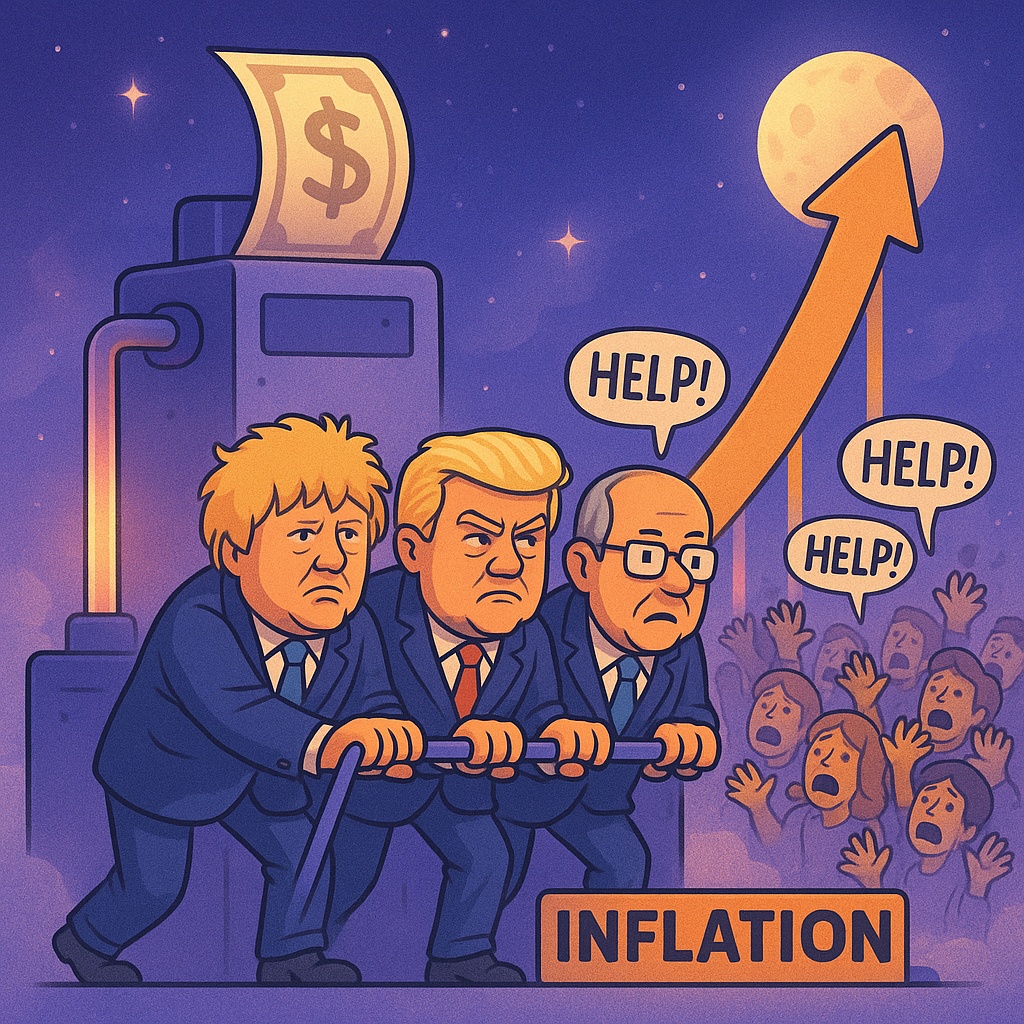
Inflation returned with force. Prices climbed, interest rates surged, and the concepts once confined to classrooms suddenly appeared in supermarket receipts and mortgage statements. The economic forces we believed we had outgrown turned out to be very much alive.
The uncomfortable truth revealed by the data is that no society, however modern or confident, is exempt from the consequences of expanding money faster than the real economy beneath it.
Inflation was not supposed to be our problem. But it is. And the numbers explain why.
Understanding why money supply drives inflation
At its core, inflation reflects a simple imbalance.
The real economy produces goods and services. The financial system supplies the money used to purchase them.
When the amount of money grows more quickly than the amount of real output available, prices must eventually adjust upward. This mechanism is longstanding and unavoidable.
Modern central banks do not rely on physical printing presses. Instead, they expand broad money, which includes cash, deposits and credit created through lending. This is the money that circulates daily and determines purchasing power.
When broad money grows modestly, the system stays stable. When it grows significantly faster than real output, inflation develops. When it grows sharply, inflation becomes almost guaranteed.
The modern illusion of immunity
History offers many examples of this pattern.
Empires that flooded markets with bullion believed they were creating wealth, only to discover they were raising prices. Industrial nations financed wars and social programmes with rapid monetary expansion and experienced decades of inflation. In the 2010s, many Western officials expressed confidence that new policy tools had permanently contained inflation risks.
Yet the underlying relationship between money and prices did not disappear. It was simply forgotten. The events of the early 2020s made that clear.
How the data was analysed
To understand the inflation surge of the 2020s, 50 years of annual data were retrieved from the World Bank’s public data platform, focusing on two indicators:
- Broad money growth (percent per year)
- Consumer price inflation (percent per year)
Countries analysed: United States, United Kingdom, Australia.
The timeline was divided into three periods to examine structural changes:
- Pre-COVID baseline (2015–2019)
- COVID monetary expansion (2020–2021)
- Post-COVID inflation surge (2022–2024)
After processing, two CSV files were produced:
graphic_us_uk_aus_timeseries.csv— year-by-year monetary and inflation datatable_us_uk_aus_summary.csv— period averages
These datasets form the basis of the graph and tables included below.
Money supply vs inflation, 2015–2024
The first view is a time series comparison. It places annual broad money growth and consumer price inflation on the same timeline so you can see when the money supply jumps, and when inflation responds.
On the finished chart, the story is clear. Broad money growth breaks sharply higher in 2020 and 2021. Inflation stays low initially, then rises in 2022 and 2023. The lag is visible even before you run any statistical tests. It is the textbook transmission mechanism drawn on real data.
Summary of pre-COVID, COVID and post-COVID trends
To make the pattern easier to digest, the averages are split into three focused tables—one per country. Each table compares broad money growth and inflation across the same three phases.
| Period | Avg money growth (%) | Avg inflation (%) |
|---|---|---|
| 2015–2019 | 4.84 | 1.55 |
| 2020–2021 | 17.03 | 2.97 |
| 2022–2024 | 0.47 | 5.02 |
| Period | Avg money growth (%) | Avg inflation (%) |
|---|---|---|
| 2015–2019 | 4.58 | 1.59 |
| 2020–2021 | 9.72 | 1.75 |
| 2022–2024 | 2.85 | 6.0 |
| Period | Avg money growth (%) | Avg inflation (%) |
|---|---|---|
| 2015–2019 | 6.72 | 1.65 |
| 2020–2021 | 10.18 | 1.86 |
| 2022–2024 | 6.12 | 5.12 |
You can download the aggregated phase averages used in these tables as a CSV file: Download summary CSV
Read row by row, each table shows the same progression: a relatively stable pre-COVID baseline, a sharp increase in money growth during 2020–2021, and a later period in which inflation is significantly higher than before. The exact numbers differ, but the sequence is consistent.
What the data shows
1. Money supply increased dramatically during the COVID period
The graph and tables both show that broad money growth rose sharply in all three countries from 2020 to 2021. The United States experienced the steepest increase, with growth rising to levels more than three times higher than the previous five-year average. The United Kingdom and Australia showed similar, though slightly smaller, upward breaks from long-term trends.
These changes are historically large and clearly identifiable on the graph as abrupt jumps.
2. Inflation rose 12 to 24 months after the monetary expansion
The inflation lines on the graph remain subdued during 2020–2021 but rise sharply in 2022–2023. This lag is consistent with historical behaviour: money supply expansions take time to filter through spending behaviour, wages, supply chains and asset markets before appearing in consumer prices.
3. Inflation remained elevated even after money growth slowed
Although broad money growth returned toward normal or even declined after 2021, inflation did not immediately fall. This reflects the fact that inflation adjusts to the stock of money already created, not merely the current rate of change. The elevated inflation of 2022–2023 corresponds directly to the prior expansion.
4. Supply chain disruptions amplified but did not fundamentally drive inflation
Pandemic-related supply constraints and geopolitical disruptions intensified price pressures. However, the alignment between broad money expansion and inflation timing demonstrates that these shocks were accelerants, not the primary cause.
Context, hindsight and responsibility
The extraordinary uncertainty of 2020 prompted aggressive fiscal and monetary actions across the world. Governments and central banks prioritised economic stability, and in many cases such intervention was necessary.
However, the magnitude of monetary expansion in 2020–2021 went far beyond normal crisis management. Historical evidence and the data examined here indicate that such expansions reliably generate inflation within a few years.
Two truths coexist: the actions taken were understandable, and the consequences were predictable.
How to evaluate monetary responsibility
Members of the public can monitor monetary trends with simple, objective indicators:
- Compare broad money growth to real GDP growth. Sustained divergence suggests inflation pressure.
- Watch for sudden multi-year jumps in money growth.
- Understand that inflation often reflects policy decisions made one to two years earlier.
- Examine multi-period averages rather than single-year changes.
- Consult publicly available monetary data regularly.
These indicators require no specialised training and are directly sourced from public datasets.
Conclusion
The inflation experienced across the Western world in the early 2020s was not an unexpected anomaly. It was the predictable outcome of a rapid and unprecedented expansion of broad money during the pandemic period.
Once money supply growth significantly outpaced real economic output, inflation became unavoidable. The subsequent rise in prices reflects economic principles that have held across centuries and societies.
Money creation is not without consequence. Its effects are delayed, but they always arrive.
Inflation was not supposed to affect advanced economies in this way. But it did—because the fundamental relationship between money and prices has not changed, even if modern confidence suggested otherwise.
Short reference for readers
All monetary and inflation figures presented in this article are sourced from the World Bank’s publicly available indicators on broad money growth and consumer price inflation. The dataset covers 1976–2024 for the United States, United Kingdom and Australia. The analysis shows that significant monetary expansion in 2020–2021 was followed by elevated inflation in 2022–2023.
Full data methodology and sources
Source: World Bank Open Data.
Indicators used:
- Broad Money Growth, annual percentage change — indicator code
FM.LBL.BMNY.ZG - Inflation, Consumer Prices (annual percentage change) — indicator code
FP.CPI.TOTL.ZG
Countries covered: United States (USA), United Kingdom (GBR), Australia (AUS).
Period analysed: 1976–2024, segmented for focused comparison into 2015–2019 (baseline), 2020–2021 (COVID monetary expansion), and 2022–2024 (inflation surge).
Original data was retrieved from the World Bank API in JSON format. Annual values for each indicator were extracted
and aligned by country and year. Missing or undefined values were removed. Averages were calculated across the
three defined time periods. Two CSVs were generated for transparency and reproducibility:
graphic_us_uk_aus_timeseries.csv (year-by-year series) and
table_us_uk_aus_summary.csv (structured summary table). No smoothing, filtering or subjective
adjustments were applied.
You can download the exact processed datasets used for the chart and tables: